Affichage des articles dont le libellé est Week 3. Afficher tous les articles

lundi 4 septembre 2017

Topic Research: Babylonia

For this step in my research, I decided to read a few stories from the ancient Babylonian religious tradition. As a note, the names in the different resources do not always have the same spelling, since they are transcribed from cuneiform.

Marduk vs. Tiamat: The first story tells of a battle between Marduk and Tiamat. Tiamat , who appears as water, a woman, or a dragon, is the personification of the sea, and she rose up in battle against the gods. They sent Marduk, who defeated her with his Evil Wind and an arrow, then formed the earth, particularly Mesopotamia, from her body. This story forms the basis of Babylonian cosmogony.

Image result for marduk tiamat
The Battle. Web Source: Mesopotamian Gods.

Ludlul bel nemeqi (aka The Poem of the Righteous Sufferer or I Will Praise the Lord of Wisdom):
The second story is a poem that tells the story of Shubshi-meshre-Shakkan, a noblemen who fell from grace in the eyes of the king and lost all of his property, friends, and health thanks to some conniving courtiers. On his deathbed, Marduk sends a priest to save him.

Inanna's Descent into the Netherworld - Inanna, a goddess who goes to visit her sister Ereshkigal in the netherworld. Her sister forces her to strip off her jewelry and fine clothes and keeps her prisoner as a corpse. Her servant, Ninshubur, sends two demons, called gallas, to rescue her. However, a substitute is necessary. Inanna convinces the demons not to take her servant, sons, or beautician, who are all in mourning for her, but her husband is not in mourning, so she becomes angry and gives him to the gallas as her substitute.

Marriage of Inanna and Dumuzi
Inanna and Dumuzi. Web Source: Ancient History Encyclopedia.

Another interesting character, who I have not found a story about but who might be useful in framing the project, is Nabu, Marduk's scribe and sometimes son. He is the god of scribes and writing, and writes the fate of the land each year after Marduk judges it.


samedi 2 septembre 2017

Feedback Strategies: Praise, Criticism, and Encouragement

As I mentioned in my first post on feedback, I am generally a fan. This week, I read the articles "Try Feedforward Instead of Feedback" and "Presence not Praise: How to Cultivate a Healthy Relationship with Acheivement," both of which looked at styles of feedback. I have mixed opinions about both of them.

As suggested in the title, the author of "Try Feedforward Instead of Feedback" suggests that forward-focused suggestions are more beneficial than feedback on past performances. While I agree that a future-oriented response can be positive, sometimes a person knows the goal but is unsure to what degree they have met it. In these instances, an external eye and feedback on past performances is also useful in acheiving a future goal.

I am probably more in agreement with the second article, though I have to admit my first thought was, but I like praise. Upon a more thorough reading, I realized that I actually do agree that presence is a more necessary foundation, particularly in the context of raising a child. In addition, I remembered times where praise has made me more nervous. So while I still think there is a place for giving a positive or encouraging word about someone's character or performance, I can see how it might not should be the basis of a learning environment.

In general, when I have given feedback in school before, the instructor has specified that vague praise is not the goal, so I have focused on giving comments on specific parts of the assignment, whether done well or poorly. I also have found that praise is useful in mitigating criticism so it does not sound as harsh. Both praise and criticism should have the goal of building someone up and helping them do better work.

the-power-of-encouragement
Encouragement. Web Source: Inked Weddings.


vendredi 1 septembre 2017

Week 3 Story: The Judgement of Malchus


“Malchus of Antioch, do you know why you have been called before this court today?”

“Yes your lordship. I am guilty of the death of one Margaret of Antioch, a brave and noble woman of Christ.”

The provost frowned. “Far from it, for her death was upon my order.”

“Then you are guilty as well, your lordship.”

“And that is why I have summoned you all here today,” said a loud voice from the back of the room.

Looking around, Malchus noticed that he and Olybrius, the provost, had been joined not by Olybrius’ soldiers but by a dragon, an unsettling young man, and two other figures, both very bright. He thought it was one of the latter two that had spoken, but he was not sure which one.

“Tell us what you have done to the woman who was called Margaret,” said one of the bright ones.

The dragon growled at the mention of her name. “I fully intended to eat her, but she made the sign of the cross and I was forced to back down.”

“And you, Veltis?”

The strange young man shifted uncomfortably. “I am ashamed to admit that she bested me as well.” He rubbed his neck. “I couldn’t stop myself - every question she asked I answered. In the end, she made the ground open up and swallow me.

“Olybrius, son of Adam, what was your relationship with this woman?”

The provost looked annoyed. “She was the most beautiful girl I had seen in a long time. I intended to marry her, but she had betrayed our gods for a crucified one, which was most unseemly. I had her tortured multiple times, but she refused to return to our beliefs. At last I commanded my hangman to kill her, and this time there was no miraculous rescue.”

“And you Malchus, son of Adam - are you the hangman of whom Olybrius spoke?”

“To my everlasting shame, sir.” Malchus looked at his hands. “She asked for a bit of time to pray, and I gave it to her. But really it was for myself sir - I needed the time to gather up my courage. How could I kill this woman who had bested a dragon and come out alive from boiling water? But then, I’d seen the provost kill the 5000 men who converted because of her. So I wasn’t sure. But after hearing her pray, pray for forgiveness for all of us - for me - who had tortured her and were going to kill her - I couldn’t do it. And that voice - the voice from heaven - it said it granted her prayers, sir.” His voice was trembling.

“And yet the woman is dead,” said the other bright one.

“Yes sir. She told me that I might have no share with her if I did not cut off her head. So I did.” Malchus covered his face, and his shoulders shook.

“I see.”

The first bright one seemed to have made his judgement. “You all have done well in persecuting this woman. Not as well as I might have hoped, since she bested you, but that is to be expected when dealing the Enemy. You will certainly be rewarded by Our Father Below.”

“Wait just a moment,” said the second. “I believe Malchus belongs to me.”

Malchus began to be rather terrified, as the second seemed far more likely to judge him.

“Not at all. Did he not kill one of your people’s so-called saints? What more does it take to come Below?”

“He killed her, yes, but she requested that he be forgiven before her death. He has repented and believes, and that is all it takes to come Above. You have the other three, let me take this one.”

“Oh alright, have it your way. I’ve got three times as many as you.” He led the dragon, Veltis, and Olybrius away, leaving Malchus alone with the second.

“Malchus, you shall experience all the torture on earth that you have dealt this woman. But you shall one day see her again in paradise.”

Malchus knelt in gratitude.

“Do not kneel to me, but look ever heavenwards.”

When Malchus looked up, the figure had disappeared.
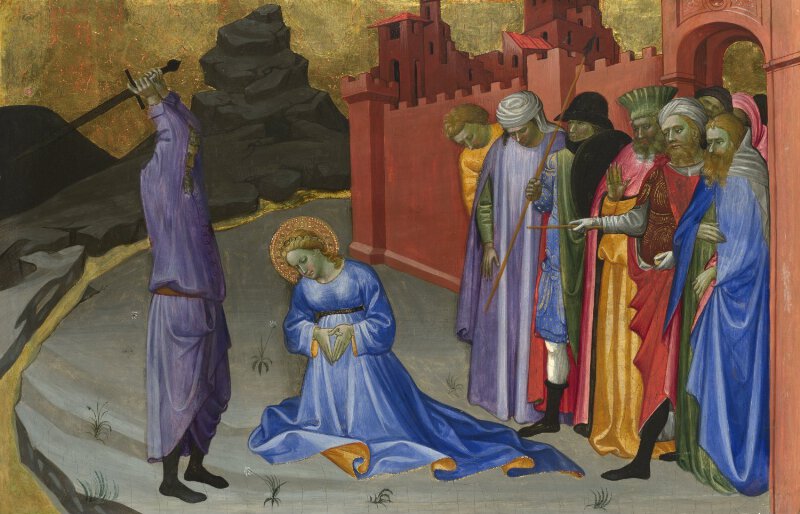
Image result for the beheading of saint margaret
The Beheading of Saint Margaret. Web Source: The National Gallery.

Author’s note: This story is based on the story of St. Margaret, from The Golden Legends. She was raised by her nursemaid, who converted her to Christianity. The provost wanted to marry her, but wanted her to renounce Christianity first. When she refused, he had her imprisoned, tortured, and eventually killed. During her imprisonment, she defeated the demon Veltis. I wanted to explore the story from the perspective of the other characters, particularly the hangman who beheaded her against his own wishes. In this story, the characters responsible for her death are judged by a demon and an angel. The demon’s language is partially based on that of The Screwtape Letters.


Bibliography: “Saint Margaret,” Voragine's The Golden Legend, link to the reading online.

mercredi 30 août 2017

Reading Notes: Women Saints, Part B


After finishing the second half of the reading from the Golden Legends, I am extremely curious as to whether women frequently disguised themselves as men and became monks in the Middle Ages, as this theme appears in several stories from both halves. The phenomenon is especially intriguing to me because I would have assumed they could have just joined abbeys as nuns, though I suppose this would not have served as well as a disguise, nor would it have set the stage for the accusation of sexual immorality as well. 

This set of stories contained more adventures and less torture, which was nice. However, I do not think they delved as deeply into the women's psyches as the previous stories. So with an eye towards the retelling, I think it would be interesting to take a first person perspective and look more deeply into their motivations for say, becoming a monk, or their feelings as they attempted to convert people or slew dragons. I am familiar with Martha from the Bible, which would give me additional background to draw upon for her emotions and character. I like the team element of Daria's story. Even though her husband originally converted her, afterwards they worked as equals and partners in their mission. As for Cecilia, I would like to delve into what she was thinking while she preached half dead with her head partially severed. 

Another possibility, as mentioned in part A, would be to explore another figure's role. In Theodora's story, her husband is a likeable character, and the child she assumes responsibility for plays a larger role than in some of the similar stories. I was glad to know something of what happened to the child after the father/mother's death. Likewise, if I were to modernize a story, I think it would be Theodora's. I would be particularly interested in looking at battling demons in a modern context. 

Tarasque. Web Source: Je vois la vie en rose.

Bibliography: Voragine's The Golden Legend, link to the reading online.

Reading Notes: Women Saints, Part A

The stories of women saints from the Golden Legend are a striking combination of violence and innocence. In the first section, almost all of them lack worldly power, but gain some kind of agency as they hold on to their beliefs in the face of intense persecution. They are mostly young and unmarried, generally under the control of a father or husband. But through their perseverance they gain power over men, primarily to convert them, and even over the devil himself.

One of the most interesting things about these stories in general is the tone in which they are written. The violence and torture that these women undergo is described rather graphically, with a child's brains spilling onto the ground and marrow coming out of broken bones. Despite the pain, the tone still maintains a type of innocence or naivete. that seems almost paradoxical. Although the women suffer physically, they remain spiritually untouched. Because of this, the constant torture and death does not render these stories tragedies, but rather a sort of triumph.

As far as specific stories go, I am curious about Marine. Since she valued her obedience and purity, why did she confess to a sin she did not commit? The only benefit I can see is that the child was brought up in a monastery with someone who would care for them well. Mary of Egypt differs from the others both in that she does not begin her life as a steadfast believer and in that her travails are ascetic and self-inflicted.

Marine the Monk. Web Source: St. Takla. 

While I enjoyed the archaic language of these stories, I think I will have to use more modern language in my retelling. I'm less sure whether I can replicate the tone of the stories that I mentioned earlier. One possibility would be to retell them from another figure's point of view, possibly the torturer or the hangman in Margaret's story.

Bibliography: Voragine's The Golden Legend, link to the reading online.