Affichage des articles dont le libellé est Week 13. Afficher tous les articles

lundi 6 novembre 2017

Week 13 Reading Notes: The Faerie Queen, Britomart, Part B

The moralistic element is something I had heard of about Spenser, but it is somewhat strange to have personifications of vices and virtues mixed in with what otherwise has the air of a historical (although obviously romanticized) drama. The magic too has a strong allegorical element, as it rewards virtue, such as in the part about the golden girdle, which chooses Amoret. It is unclear whether some sentience is granted to the girdle or if it is more like a computer program and virtue is the password. I did not care particularly much for the allegorical parts, such as Sir Scudamour's sojourn in the house of Care, but I am more intrigued by objects that respond to good and evil.

Golden Girdle. Link.
I have to admit, it somewhat bothers me when beauty is a sign of virtue and when it can so swiftly stop anger. The men are always getting so angry, and even Britomart at times. It does not seem particularly noble to me, even though the main male characters are presented as furious and seeking revenge before they are suddenly appeased. Sir Scudamour's change of heart is more reasonable, but Sir Artegall should have not been so angry at being beaten. It actually contradicts what Spenser said earlier about knights not minding defeat.

WHAAAAAT? I want to know what happened to Amoret! She would be another interesting character to make the narrator. I like that they became friends.

I am glad that Britomart kept up her adventuring after she met and agreed to marry Artegall, as she is quite good at it. I wonder whether she continues in her disguise. It seems that dressing as a knight is not merely a way to pursue her quests, as she continues to be respected by those to whom her secret is revealed, but as a prevention against kidnapping. Beautiful ladies seem to frequently be at the mercy of those who want to marry them, so it makes sense to be a knight instead.

Bibliography: Mary Macleod's Stories from the Faerie Queen, Link.

Week 13 Reading: The Faerie Queen, Britomart, Part A

I have never read the Faerie Queen before, and I am always intrigued by women who dress up as men to become knights, like in the Alanna series by Tamora Pierce.

One character that I am particularly curious about is Glaucé, Britomart's maid. She is not frequently mentioned, except in the part that explains Britomart's backstory. There it is mentioned that she disguises herself as a squire and accompanies Britomart on her journey, but throughout the other chapters, when she would presumably be present, she is not mentioned. It is particularly curious that she is repeatedly referred to as an old nurse, yet she takes on the role of a squire, who is generally a young person. As for her rather unusual name, it appears to be drawn from Greek mythology, as is Britomart's. It would be interesting to retell the story or parts of it from her perspective.
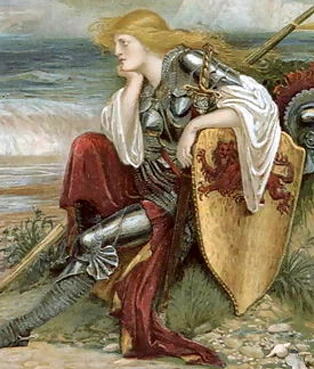
Image result for britomart faerie queene
Britomart. Web Source: Public Domain Super Heroes.

Merlin is always an interesting character, particularly as he knows everything that is going to happen.

One especially enjoyable scene was when Glaucé encourages Britomart to take up arms and find the man she loves with inspiring stories of women in arms from history. One of these women, a Saxon queen named Angela, provides the armor that Britomart needs for her quest. According to one report, Anglia was named after the daughter of a Saxon duke, Angela. However, I am not sure whether this is actually the character's namesake.

What is the backstory of the enchanted spear? Who enchanted it and how does it work? Oh maybe I could personify the spear and her sword. Perhaps it is their respect for her character, rather than her goodness itself, that gives her power. The spear and the sword could initially be rivals, but then grow in their desire to defend Britomart and further her quest.

Bibliography: Mary MacLeod's Stories from the Faerie Queen, Link.